Girls Adoption Connect
•
March 31, 2022
Chinese adoption & disability
In honor of the conclusion of National Disability Awareness Month, we share a part of Chinese adoption that is often overlooked: the intersectionality of adoption and disability.
Slide text
-
Slide one
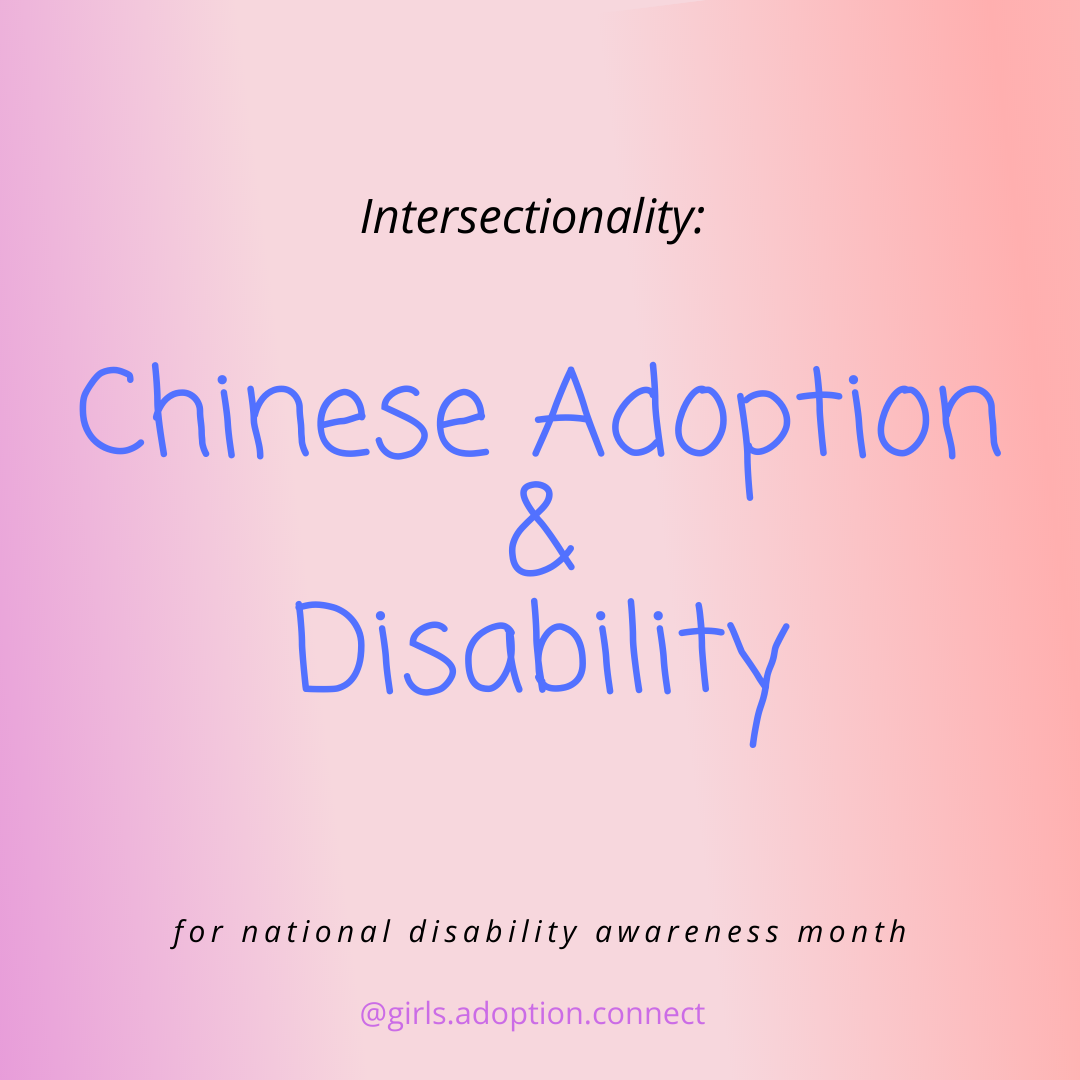
Intersectionality: Chinese Adoption & Disability. For National Disability Awareness Month @girls.adoption.connect.
-
Slide two
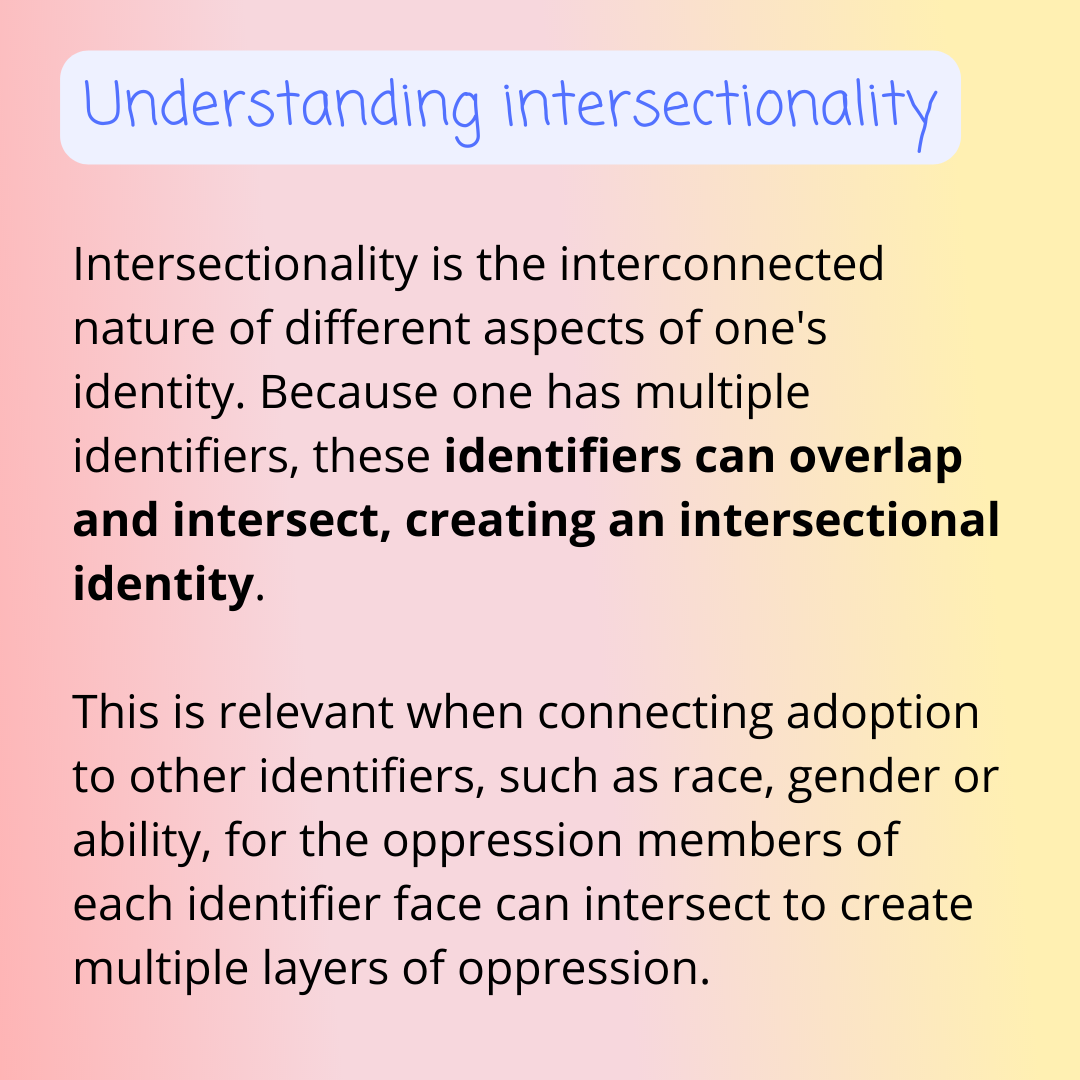
Understanding intersectionality
Intersectionality is the interconnected nature of different aspects of one’s identity. Because one has multiple identifiers, these identifiers can overlap and intersect, creating an intersectional identity. This is relevant when connecting adoption to other identifiers, such as race, gender, or ability, because the oppression members of each identifier face can intersect to create multiple layers of oppression.
-
Slide three
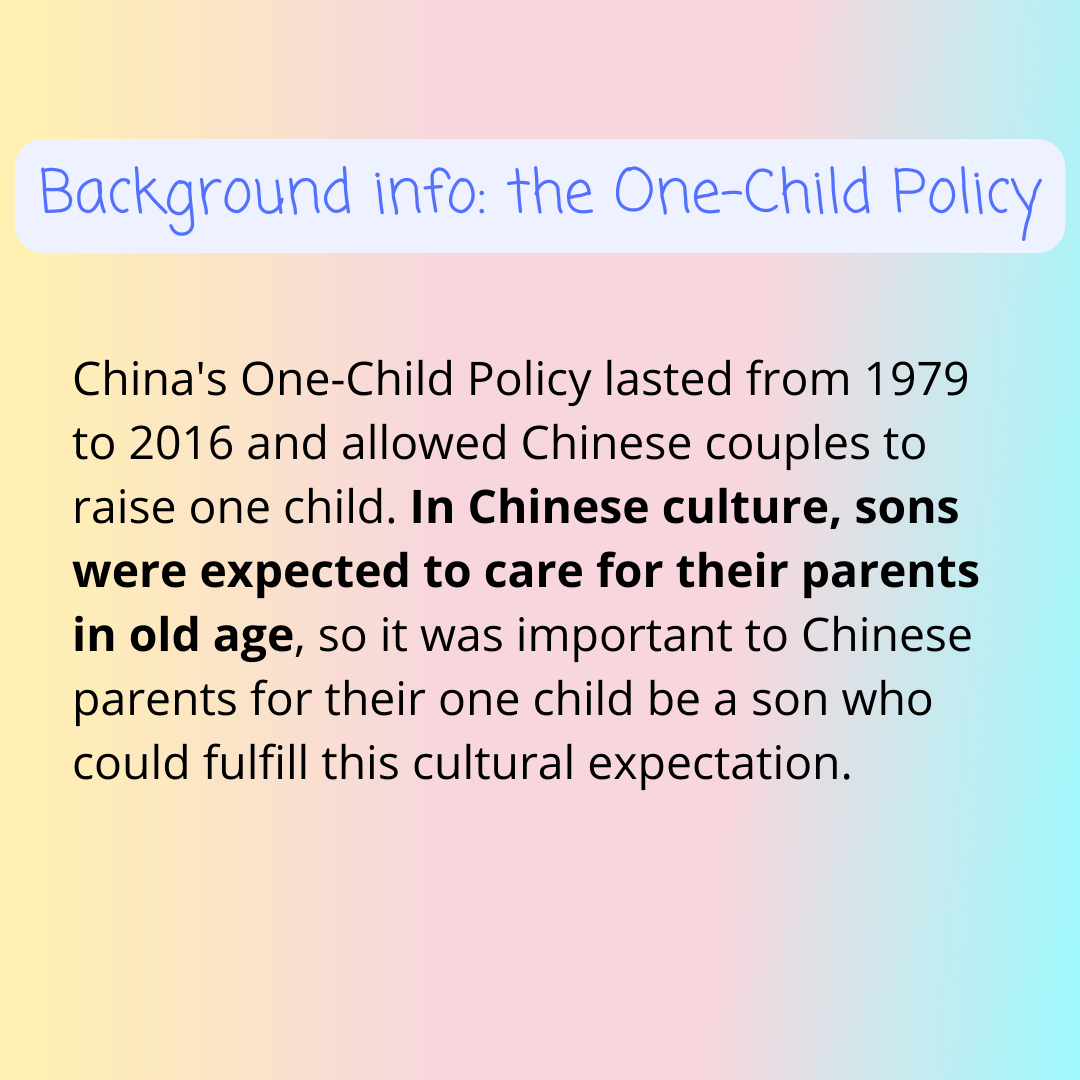
Background info: the One-Child Policy
China’s One-Child Policy lasted from 1979 to 2016 and allowed Chinese couples to raise one child. In Chinese culture, sons were expected to care for their parents in old age, so it was important to many Chinese parents that their one child be a son who could fulfill this cultural expectation.
-
Slide four
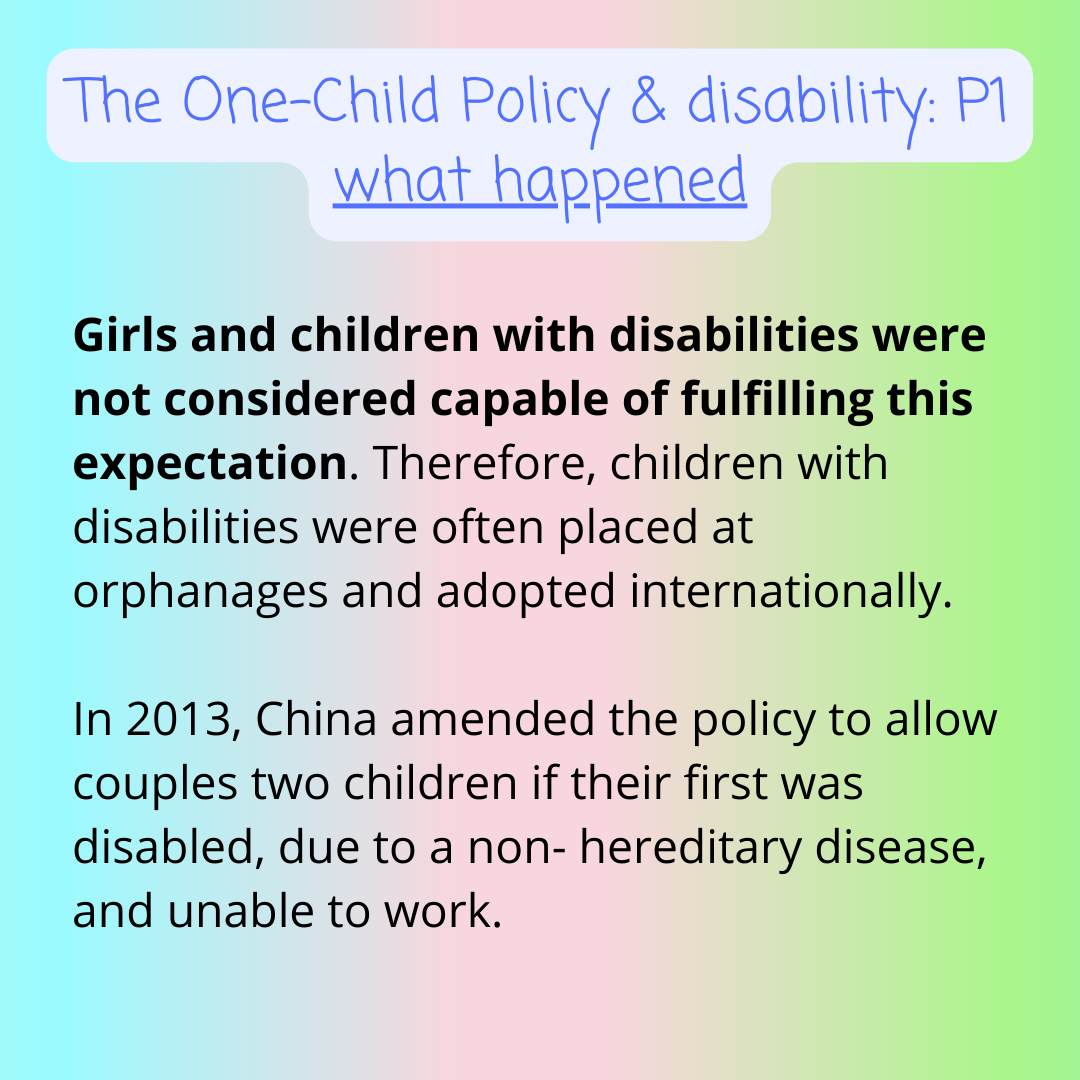
The One-Child Policy & disability (Part 1): what happened
Girls and children with disabilities were not considered capable of fulfilling this expectation. Therefore, children with disabilities were often placed in orphanages and adopted internationally. In 2013, China amended the policy to allow couples to have two children if their first child was disabled due to a non-hereditary disease and unable to work.
-
Slide five
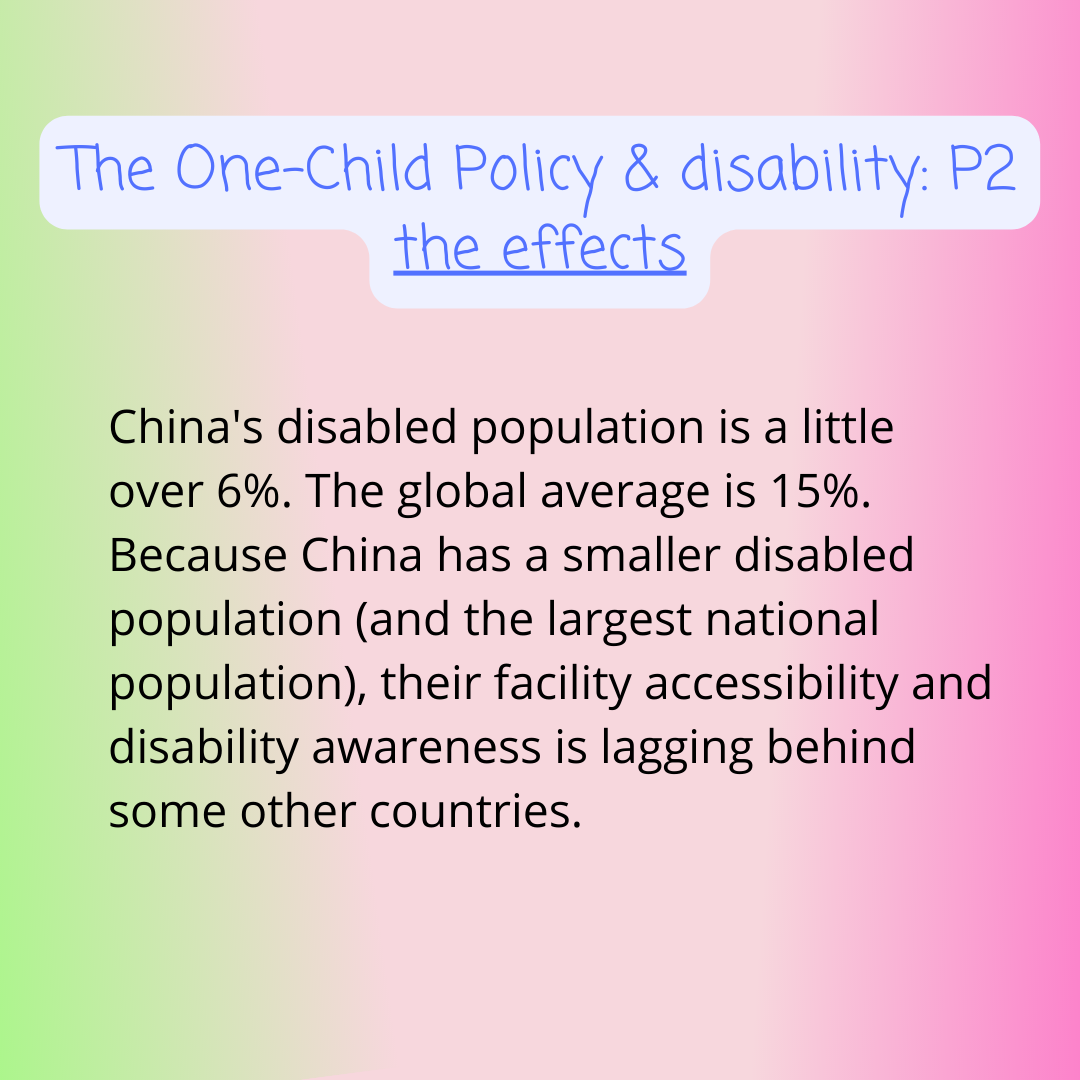
The One-Child Policy & disability (Part 2): the effects
China’s disabled population is a little over 6%, while the global average is about 15%. Because China has a smaller recorded disabled population—despite having the largest national population—facility accessibility and disability awareness have lagged behind those of some other countries.
-
Slide six
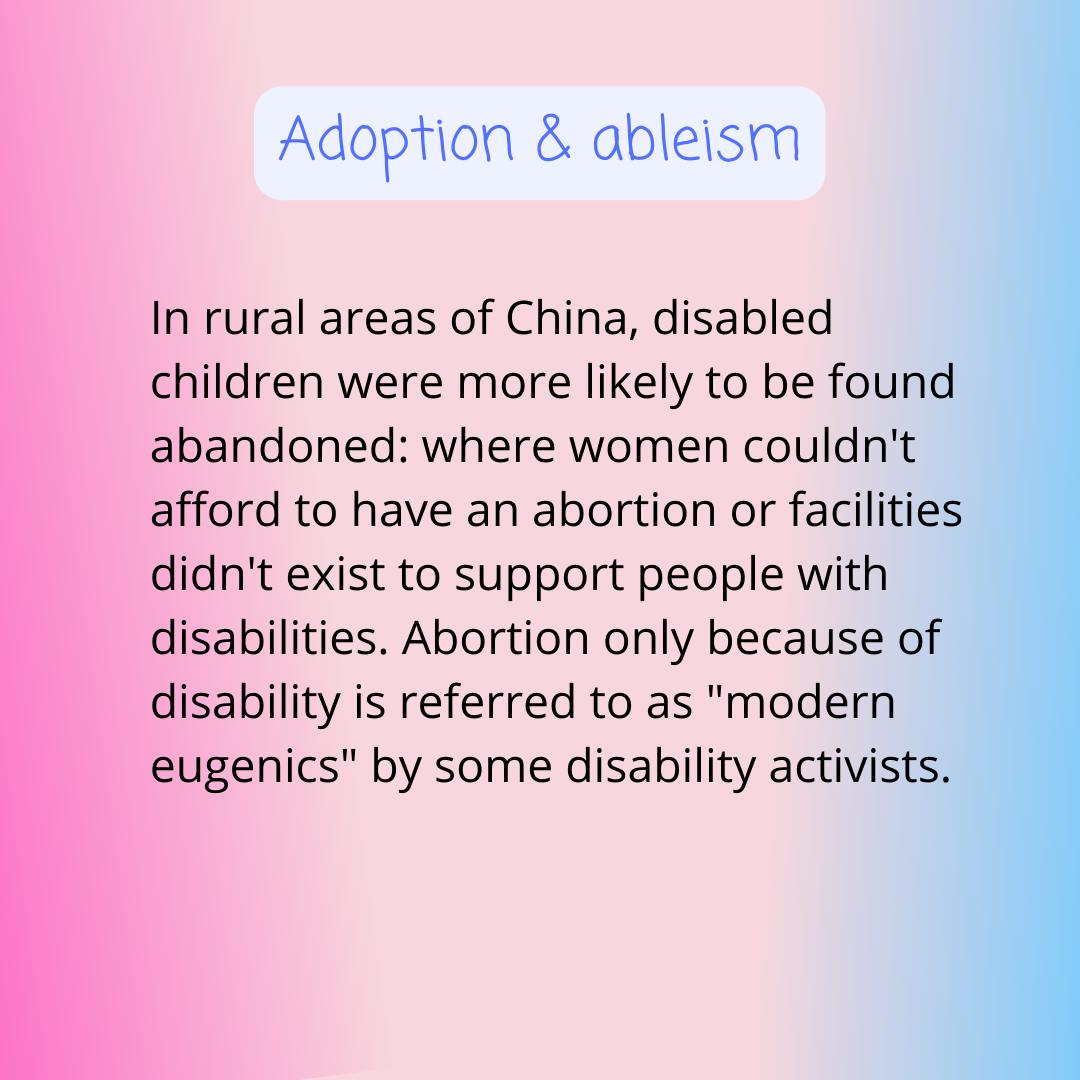
Adoption & ableism
In rural areas of China, children with disabilities were more likely to be abandoned, especially where families could not afford abortion services or where facilities to support people with disabilities did not exist. Abortion based solely on disability is referred to as “modern eugenics” by some disability activists.
-
Slide seven
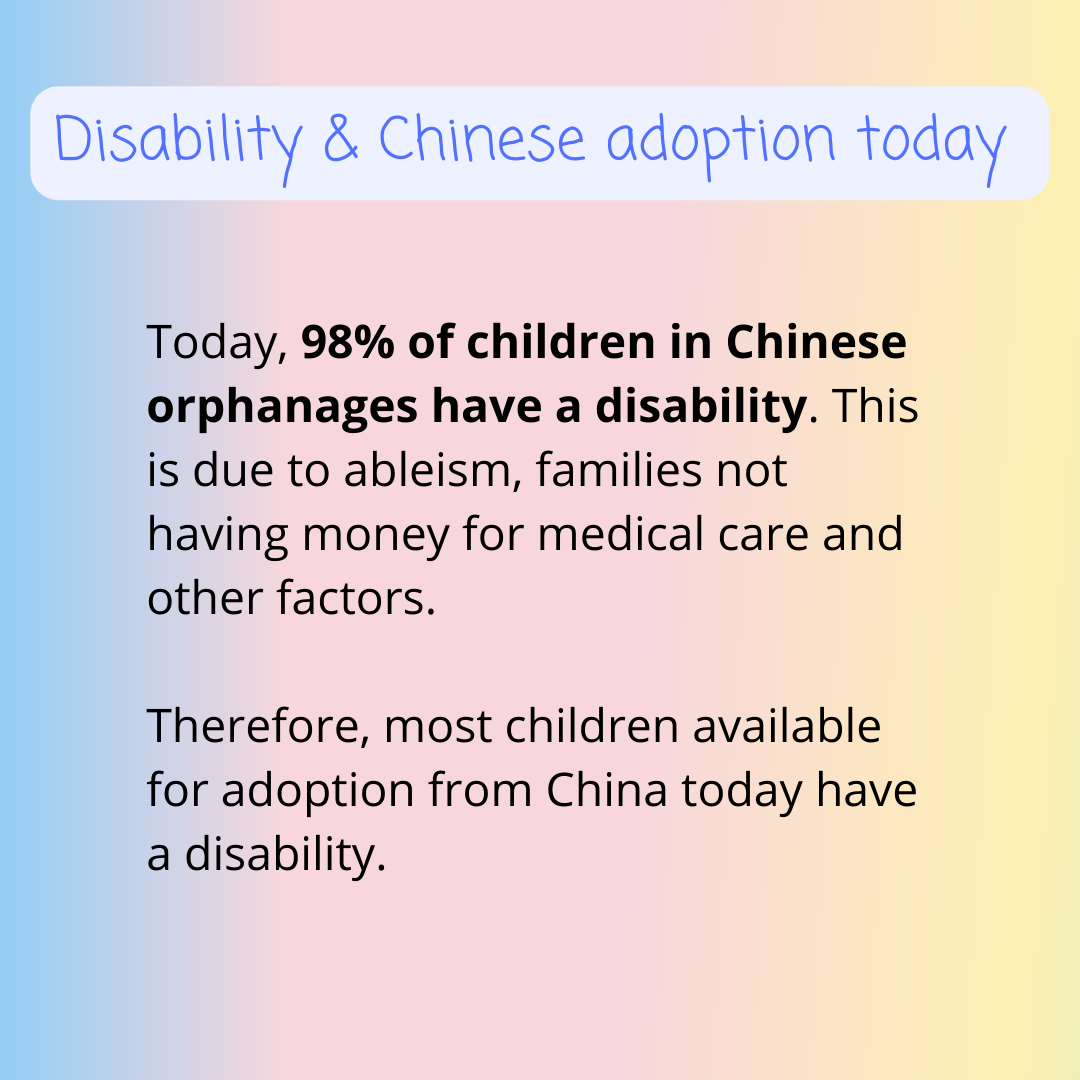
Disability & Chinese adoption today
Today, approximately 98% of children in Chinese orphanages have a disability. This is due to ableism, lack of access to medical care, financial barriers, and other systemic factors. As a result, most children available for adoption from China today have a disability.
-
Slide eight
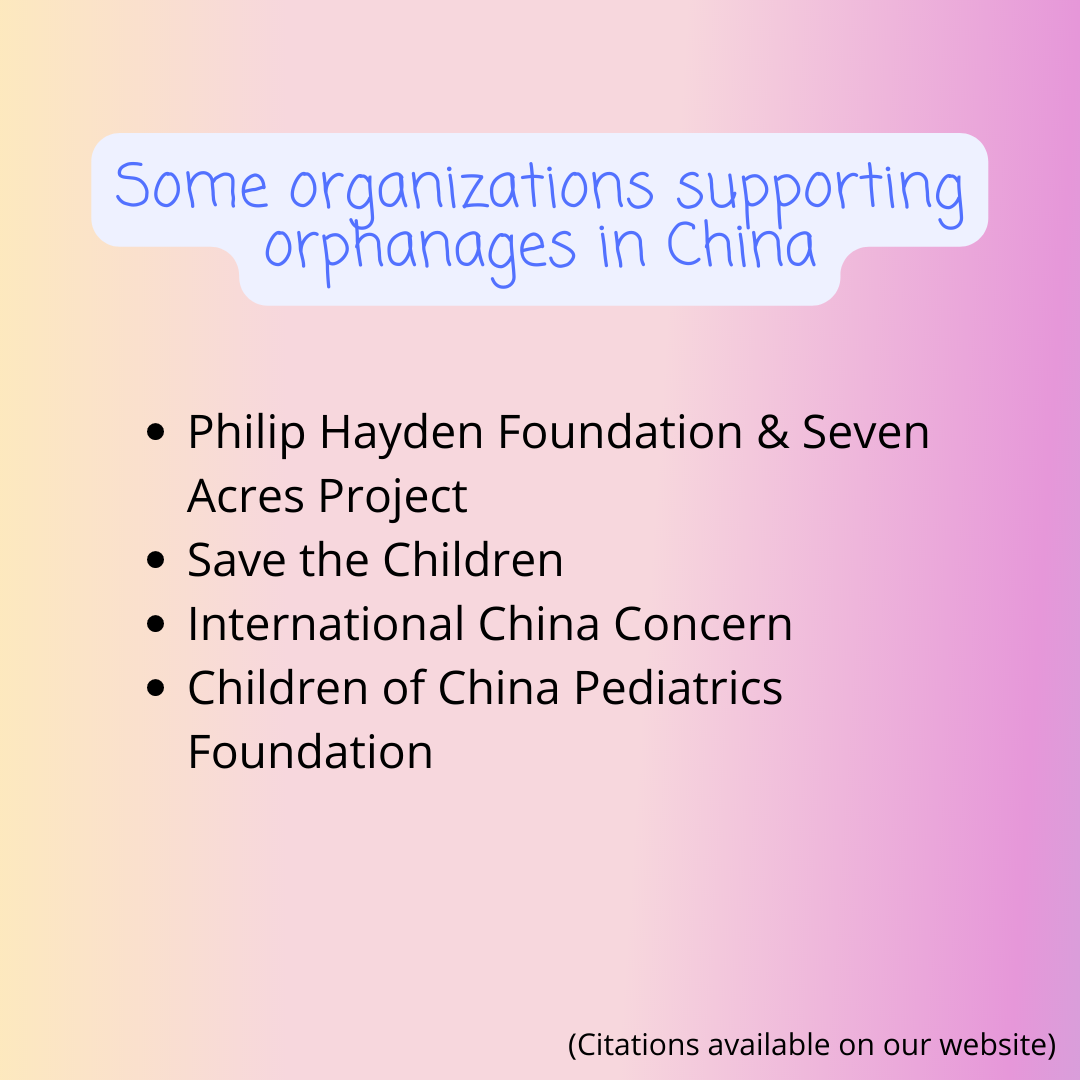
Organizations supporting orphanages in China
Philip Hayden Foundation & Seven Acres Project, Save the Children, International China Concern, Children of China Pediatrics Foundation.
Sources:
-
“Adopting a Child From China FAQs: Commonly Asked Questions About Chinese Adoption.” New Beginnings.
https://www.new-beginnings.org/adoption-programs/adopting-a-child-from-china/china-adoption-faqs/
-
“Disability Inclusion.” The World Bank, 2021.
https://www.worldbank.org/en/topic/disability#1
-
Hawkins, Amy. “What Does the End of the One-Child Policy Mean for China’s Disabled Population?” The New Statesman, January 14, 2017.
https://www.newstatesman.com/politics/2017/01/what-does-end-one-child-policy-mean-chinas-disabled-population
-
Fisher, Max. “China’s Rules for When Families Can and Can’t Have More Than One Child.” Washington Post, November 16, 2013.
https://www.washingtonpost.com/news/worldviews/wp/2013/11/16/chinas-rules-for-when-families-can-and-cant-have-more-than-one-child/
-
Pletcher, Kenneth. “One-Child Policy: Chinese Government Program.” Encyclopedia Britannica, September 15, 2021.
https://www.britannica.com/topic/one-child-policy